
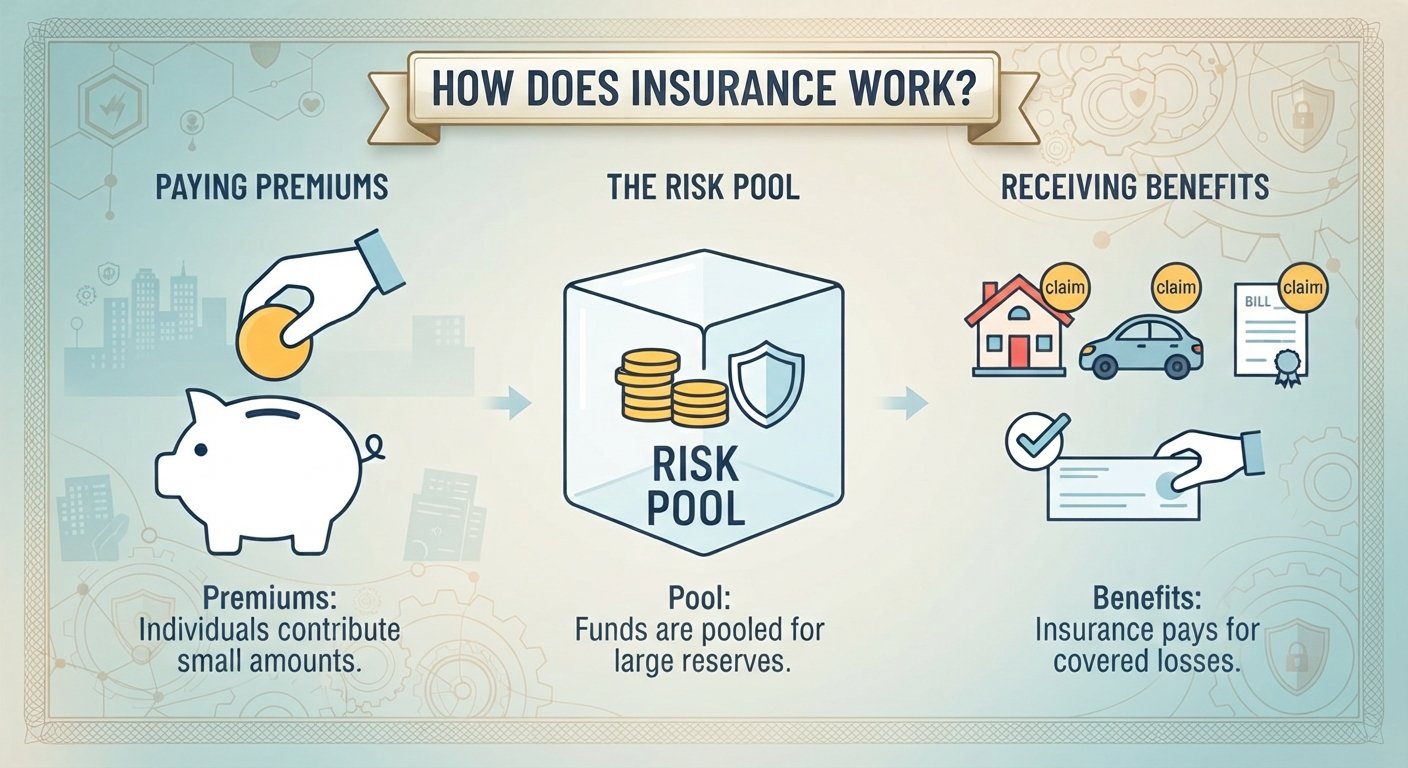
Insurance can seem complicated when you first encounter terms such as policy, premium, coverage, deductible, claim, insurer, and payout. However, the basic idea behind insurance is relatively simple. Insurance is a financial arrangement that helps people and organizations manage certain risks by transferring some of the financial consequences of covered losses to an insurance company.
In exchange for insurance protection, the policyholder pays a premium according to the terms of the policy. If a covered event occurs, the policyholder can generally report the loss to the insurer and submit a claim. The insurance company then reviews the claim to determine whether the loss is covered and how much, if anything, the policy provides for that loss.The process does not begin when an accident or other unexpected event happens. It begins when someone identifies a risk, looks for appropriate protection, applies for insurance, and enters into an insurance contract with an insurer. Understanding the complete process can help beginners know what happens before, during, and after an insurance claim.
1.Identifying a Risk
The first part of the insurance process is recognizing a financial risk that could cause a significant loss.
People face many different risks in everyday life. A driver may be involved in a vehicle accident. A homeowner may experience property damage from a covered event. A person may face unexpected medical expenses. A family may lose an important source of income if a breadwinner dies. A business may experience property damage or another covered loss.
Insurance exists because some unexpected losses can be financially difficult to handle alone. Instead of relying entirely on personal savings to deal with every possible major loss, a person may purchase insurance designed to provide protection against certain specified risks.
The important point is that insurance does not remove the risk itself. A person can still have an accident, become ill, or experience property damage. Insurance is intended to help manage the financial consequences of certain covered events.
2.Choosing the Type of Insurance
After identifying a risk, the next step is determining what type of insurance may be appropriate.
Different insurance policies are designed for different purposes. Someone who owns a car may consider auto insurance. A homeowner may need homeowners insurance. A person who rents a property may consider renters insurance. A family may consider life insurance when financial dependents rely on someone’s income.The type of insurance selected should match the risk that needs to be managed. Buying a policy without understanding its purpose can create a false sense of security.
For example, having an insurance policy does not automatically mean that every possible problem involving a vehicle, home, business, or person will be covered. The actual protection depends on the policy purchased.
3.Applying for Insurance
Once a person decides what type of insurance they need, they generally apply for a policy.
During the application process, the insurer may request information relevant to assessing the risk. The information required depends on the type of insurance. For example, an auto insurer may request information about the vehicle and driver, while a property insurer may ask questions about the property and its characteristics.
The information provided during an application can be important because insurance companies use relevant information to evaluate risk and determine whether and under what terms they are willing to provide coverage.
Applicants should provide accurate and complete information. Providing incorrect or misleading information can create problems later, particularly if the information is relevant to a claim or the terms of the policy.
4.The Insurance Company Evaluates the Risk
After receiving an application, the insurer evaluates the information provided. This process is commonly associated with underwriting.
Underwriting involves assessing the characteristics and level of risk associated with providing insurance. The insurer uses information relevant to the particular type of policy to determine whether coverage can be offered and under what terms.The insurer may also determine the premium that will be charged for the policy. Different people or properties can receive different prices because their risk characteristics may differ.
For example, two drivers may want similar auto insurance but have different driving histories, vehicles, locations, or other relevant characteristics. Their premiums may therefore be different.The exact factors considered depend on the insurance type, insurer, applicable laws, and other circumstances.
5. The Policy Is Issued
If the insurer agrees to provide coverage and the applicant accepts the terms, the insurance policy is issued.
An insurance policy is a contract that describes the agreement between the policyholder and the insurer. It sets out important information about the protection being provided, the responsibilities of the parties, and the circumstances under which the insurer may provide benefits or pay covered losses.
The policy may identify the insured person or property, the period of coverage, the premium, coverage amounts, applicable deductibles, limitations, exclusions, and other conditions.
This is why a policy should not be treated simply as a receipt showing that insurance was purchased. It is an important legal and financial document that explains the agreement.
6.The Policyholder Pays the Premium
After obtaining insurance, the policyholder must pay the required premium according to the policy’s payment terms.
A premium is the amount charged by an insurer for insurance coverage. Depending on the insurance product and payment arrangement, premiums may be paid monthly, quarterly, annually, or according to another schedule.
Paying the premium is important because insurance coverage generally depends on the policy remaining in force according to its terms. If required payments are not made, the policy may be affected, including possible cancellation or lapse depending on the applicable rules and policy conditions.
The premium is therefore one of the ongoing financial responsibilities associated with maintaining insurance.
7.The Policy Remains in Force
Once coverage has been issued and the required conditions are satisfied, the policy remains in force during its applicable coverage period, subject to its terms.
During this period, the policyholder may continue paying premiums and complying with the policy’s requirements. The insurer, in return, provides the protection described in the contract for covered risks.It is important to understand that having active insurance does not mean that every event will result in an insurance payment. A loss must generally fall within the scope of the policy and satisfy its applicable conditions.
For example, a policy may cover certain types of property damage but exclude specific causes of loss. A policy may also have a maximum amount the insurer will pay for a particular type of covered loss.
8. A Covered Event Occurs
The next stage begins when an unexpected event occurs.
This could be an automobile accident, covered property damage, an eligible medical expense, a covered theft, or another event that falls within the type of risk addressed by the policy.At this point, the policyholder should avoid assuming that the insurer will automatically pay for the loss. The event needs to be reported and evaluated under the policy.
The policyholder should also take reasonable steps to prevent additional damage when appropriate and safe to do so. Depending on the situation, documentation such as photographs, receipts, reports, medical records, repair estimates, or other information may become important.
- The Policyholder Reports the Loss
When a covered or potentially covered event occurs, the policyholder generally reports the incident to the insurance company.
This begins the claims process.The exact reporting procedure varies between insurers and types of insurance. Some claims may be reported online or through a mobile application, while others may require a phone call or additional documentation.
When reporting a loss, the policyholder should provide accurate information about what happened, when it happened, where it happened, and what damage or expenses resulted.
Prompt reporting can be important because insurance policies may contain requirements concerning when and how losses should be reported.
- The Insurance Company Reviews the Claim
After receiving a claim, the insurer reviews the information to determine how the policy applies to the reported loss.The insurer may ask for additional documents or information. Depending on the type and complexity of the claim, the company may assign a claims professional or adjuster to investigate the circumstances.
The review can involve determining whether the event falls within the policy’s coverage, whether any exclusions apply, whether the policyholder has satisfied relevant requirements, and how much damage or financial loss is involved.
This stage is important because the insurer cannot simply pay every claim without checking whether the reported loss is covered by the insurance contract.
- The Loss May Be Investigated
Some claims are relatively straightforward, while others require a more detailed investigation.
For example, after an auto accident, an insurer may review photographs, accident reports, statements, repair estimates, and other available information. For a property claim, the insurer may need to inspect the damage and determine the cause and estimated cost of repairs.The level of investigation depends on the nature and complexity of the claim.
An investigation does not necessarily mean that the insurer believes the policyholder has done something wrong. It is often a normal part of determining what happened and how the policy applies.
The purpose is to establish relevant facts so that the claim can be evaluated according to the insurance contract.
- The Insurer Determines Whether the Loss Is Covered
One of the most important stages of the claims process is the coverage determination.
The insurer compares the circumstances of the loss with the terms of the policy. The company considers the policy’s coverage provisions, exclusions, limits, conditions, deductible, and other applicable terms.
If the loss is covered, the insurer calculates the amount payable under the policy. If the loss is not covered, the insurer may deny the claim or determine that some portions of the loss are outside the policy’s protection.A claim can also be partially covered. For example, one part of a loss may fall within the policy while another part may be excluded or exceed a relevant policy limit.
This is why simply having insurance is not enough. Understanding what the policy actually covers is essential.
- The Deductible May Be Applied
If the policy includes a deductible that applies to the particular claim, the policyholder may be responsible for paying that amount before the insurer pays the remaining eligible loss, subject to the policy’s terms.
For example, suppose a covered loss results in $5,000 of eligible damage and the applicable deductible is $1,000. If the policy terms require that deductible to be applied, the insurer may pay $4,000 and the policyholder would be responsible for the $1,000 deductible.This is a simplified example. Actual claims can involve policy limits, exclusions, depreciation, valuation rules, multiple coverages, or other factors that affect the final amount.
The important concept is that the deductible is part of the policyholder’s financial responsibility for certain covered losses.
- The Insurer Determines the Payment Amount
After determining coverage and applying the relevant policy terms, the insurer calculates the amount payable for the claim.
The payment is not necessarily equal to the total amount the policyholder believes the loss is worth. The insurer considers the policy’s specific provisions.Factors can include the amount of eligible damage, the applicable deductible, policy limits, valuation method, exclusions, conditions, and other relevant terms.
For example, if an insured property has a covered loss, the amount paid may depend on whether the policy provides for a particular valuation method and whether the loss falls within the applicable coverage limit.
The final payment therefore depends on both the actual loss and the insurance contract.
- The Claim Is Settled or Denied
Once the claim has been evaluated, the insurer generally reaches a decision.
If the claim is covered, the insurer may approve payment according to the policy. The claim may then be settled through a payment, repair arrangement, replacement, reimbursement, or another method depending on the type of insurance and the circumstances.If the claim is denied, the policyholder should review the explanation provided by the insurer. A denial may occur because the loss is excluded, the event does not fall within the policy’s coverage, a policy condition was not satisfied, or another contractual reason applies.
A denied claim does not necessarily mean that insurance is useless. It means that the insurer determined that the particular loss did not qualify for payment under the applicable policy terms.
- The Claim Is Closed
After the claim has been resolved and the applicable payment or other settlement has been completed, the claim may be closed.However, the process does not necessarily end the policy itself. If the policy remains active and its terms continue to apply, the policyholder may still have insurance protection for future covered events.
This is an important distinction: a claim is an individual request for benefits resulting from a loss, while the insurance policy is the broader contract that may remain active during its coverage period.
What Happens to Insurance Premiums?
Many beginners wonder what happens to the money they pay as insurance premiums.
Insurance companies collect premiums from many policyholders. Insurance works partly through the pooling of risk. Many policyholders pay premiums, while only some experience covered losses during a particular period.The insurer uses collected premiums as part of the financial resources supporting claims payments and the operation of the insurance business. The exact financial structure of an insurer is more complex, but the basic concept is that risk is shared across a pool of policyholders.
For example, thousands of people may have auto insurance during a year, but only a portion of those people may experience covered accidents. The premiums collected across the pool help support the insurer’s ability to pay covered claims.
This pooling principle is one of the fundamental ideas behind insurance.
Does the Insurance Company Pay Every Claim?
No. Insurance companies do not automatically pay every claim that is submitted.A claim must be evaluated according to the applicable policy. The insurer needs to determine whether the event is covered and whether the policyholder has met the relevant conditions.
For example, a person may submit a claim for damage that is specifically excluded under their policy. In that situation, the insurer may deny the claim because the policy does not provide protection for that particular loss.Similarly, even when a loss is covered, the amount payable may be limited by the policy’s terms.
This is why understanding the policy before a loss occurs is much better than discovering its limitations for the first time during a claim.
What If the Loss Is Greater Than the Policy Limit?
Insurance policies can contain limits on how much the insurer will pay for particular types of covered losses.
For example, suppose a policy provides a $50,000 limit for a particular coverage and a covered loss results in $70,000 of eligible damage. If the policy’s limit applies to the entire loss, the insurer generally would not be responsible for paying more than the applicable limit under that coverage.The remaining financial responsibility may therefore fall on the policyholder.This demonstrates why purchasing insurance is not simply about having a policy. The amount of protection selected can also be important.
Why Reading the Policy Matters
Many people only look at the premium and assume they understand their insurance. However, the premium tells you what you are paying; it does not by itself explain the complete protection being purchased.The policy contains important information about what is covered, what is excluded, applicable limits, deductibles, conditions, responsibilities, and other requirements.Reading the policy can help a person understand what to expect if a loss occurs. It can also make it easier to identify questions that should be discussed with the insurer or a qualified insurance professional.
A person does not need to become an insurance expert to understand their policy. They should, however, know the basic terms and understand the important provisions that affect their financial protection.
A Simple Example of the Complete Insurance Process
Consider a person who purchases auto insurance for their vehicle.
First, the person identifies the need for financial protection against certain vehicle-related risks. They apply for auto insurance and provide information required by the insurer.The insurance company evaluates the application and offers a policy with specified terms and a premium. The person accepts the policy and pays the required premium.
Later, the driver is involved in an accident. The driver reports the accident to the insurer and provides the required information and documentation.The insurance company reviews the claim, investigates the accident as necessary, and determines whether the loss falls within the policy’s coverage. If the claim is covered, the insurer calculates the eligible amount according to the policy’s terms.If an applicable deductible exists, it is considered when determining the payment. The insurer then pays the covered amount or arranges the applicable settlement according to the policy.
This example shows the basic cycle of insurance: risk → insurance purchase → premium → covered event → claim → investigation → coverage decision → settlement.
Key Takeaway:
Insurance works by allowing individuals and organizations to manage certain financial risks through an insurance contract. The policyholder pays a premium in exchange for protection against specified covered risks. When a covered event occurs, the policyholder reports the loss and submits a claim. The insurer then evaluates the circumstances and applies the policy’s terms to determine whether and how much it will pay.
The insurance process involves much more than simply purchasing a policy. Understanding the policy, paying premiums on time, reporting losses properly, providing accurate information, and knowing the limits and conditions of coverage can all be important parts of maintaining and using insurance protection.
For beginners, the most important lesson is simple: insurance provides financial protection according to the terms of a specific policy, not an unlimited promise to pay for every unexpected loss.
Sources:
National Association of Insurance Commissioners (NAIC), consumer insurance education resources.
NAIC, “How Does Insurance Work?”
https://content.naic.org/consumer/how-does-insurance-work
NAIC, “Glossary of Insurance Terms”
https://content.naic.org/glossary-insurance-terms
NAIC, “Auto Insurance”
https://content.naic.org/insurance-topics/auto-insurance
Disclaimer:
This article is for general educational purposes only. Insurance rules, coverage, claims procedures, and policy requirements can vary by insurer, policy, and location. Always review your actual policy documents and consult a qualified insurance professional for advice about your specific circumstances